
Taking advantage of pension income splitting
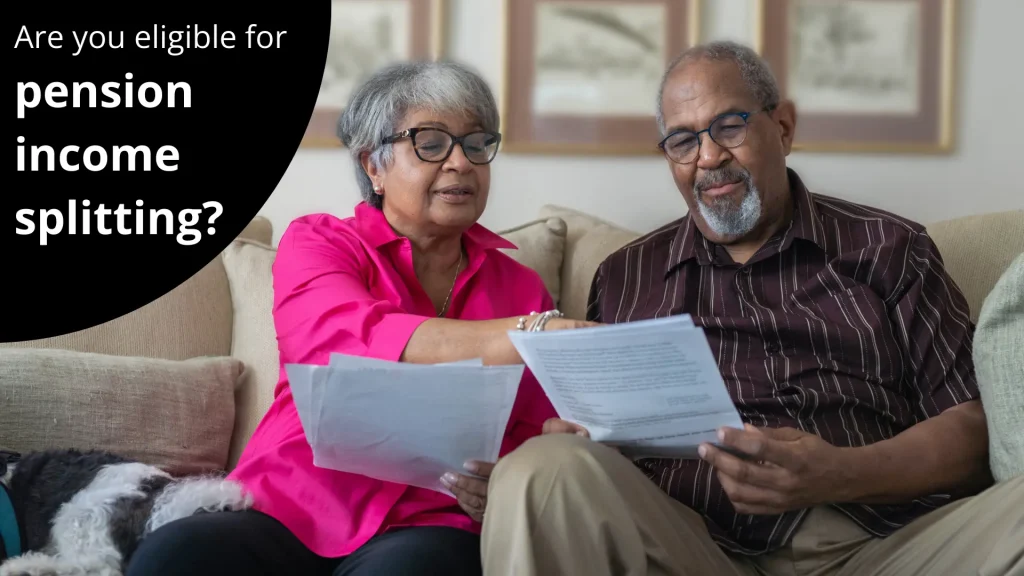
Many Canadian couples, by the time they reach retirement, have achieved most of life’s major financial goals, and the recurring costs of reaching those goals are no longer a consideration. Retirement savings are in place, most homeowners are mortgage-free, and the cost of raising (and providing a post-secondary education for) their children is something already accomplished.
However, there is one major cost which can never be left behind, and that is income tax. For many retirees, the annual tax bill represents their single largest expenditure, and our tax system recognizes this financial reality by providing a number of tax deductions and credits for which only individuals aged 65 and older are eligible.
Most Canadians aged 65 and older do claim those age-related tax deductions and credits on their annual return. There is, however, one age-related tax break of which many Canadians are unaware: pension income splitting. This lack of awareness is particularly unfortunate in light of the fact that pension income splitting has greater potential to reduce the overall family tax bill than any other single tax deduction or tax credit available to older Canadians.
Pension income splitting also offers attributes that are seldom found in other tax deduction or credit measures. First, the eligibility rules with respect to pension income splitting do not include an income ceiling (individual or family) which would limit claims which can be made. Second, there is no limitation placed on the amount by which income tax payable for the year can be reduced by pension income splitting. Third, utilizing pension income splitting does not require any expenditure of funds on the part of the taxpayer(s). And finally, no pre-planning or actual reallocation of income is needed: to benefit from pension income splitting, all that’s needed is for each spouse to file a single form (the T1032) with the CRA and to make a single entry on their 2025 tax return.
Pension income splitting basically involves taking private pension income which was received during the year by one spouse and allocating some of that income to the other spouse for tax purposes. Like all forms of income splitting, pension income splitting works because Canada has what is called a “progressive” tax system, in which the applicable tax rate goes up as income rises. For 2025, the federal tax rate applied to the first $57,375 of taxable income is 14.5%, while the federal rate applied to the next $57,375 of such income is 20.5%. So, an individual who has $100,000 in taxable income would pay federal tax of about $17,057 (14.5% of $57,375 plus 20.5% of $42,625). If that $100,000 was divided equally between such individual and their spouse, each would have $50,000 in taxable income and federal tax payable of $7,250 (14.5% of $50,000). The total federal tax bill for the family would be $14,500, saving just over $2,500 in federal tax payable for the year.
The general rule with respect to pension income splitting is that a taxpayer who receives private pension income during the year is entitled to allocate up to half that income (without any dollar limit) to their spouse for tax purposes. For pension income splitting purposes, private pension income means payments from a pension plan and, where the income recipient is aged 65 or older at the end of the year, payments from an annuity, a registered retirement savings plan (RRSP), or a registered retirement income fund (RRIF). Government source pensions, like the Canada Pension Plan, Québec Pension Plan, or Old Age Security payments do not qualify for pension income splitting, regardless of the age of the recipient.
The mechanics of pension income splitting are relatively simple. There is no need to transfer funds between spouses or to make any change in the actual payment or receipt of qualifying pension amounts, and no need to notify a pension or retirement savings plan administrator. Taxpayers who wish to split eligible pension income received by either of them must complete Form T1032, Joint Election to Split Pension Income (T1032 E (23)). That form, which is not included in the annual tax return package, can be found on the Canada Revenue Agency website at https://www.canada.ca/en/revenue-agency/services/forms-publications/forms/t1032.html, or can be ordered (in English or French) by calling the CRA’s automated forms ordering telephone line at 1-855-330-3305.
Using the T1032, the taxpayer receiving the private pension income and the spouse with whom that income is to be split must make a joint election and provide the amount of pension income to be split. Where returns are filed electronically, the completed T1032 must be retained in case the Canada Revenue Agency makes a request for it; where the returns are paper filed, the completed T1032 form is filed with each spouse’s return. Since the splitting of pension income affects the income, and therefore the tax liability, of both spouses, the election must be made and the form filed by both spouses – an election filed by only one spouse or the other won’t suffice. In addition to filing the T1032, the spouse who actually received the private pension income to be split must deduct from income the amount of eligible pension income which is being allocated to their spouse. That deduction is taken on Line 21000 of their 2025 return. And, conversely, the spouse to whom the eligible pension income is being allocated is required to add that amount to their income on the return, this time on Line 11600.
Unfortunately, the T1 package issued by the Canada Revenue Agency simply outlines the mechanics of how to carry out pension income splitting but does not provide any information on the benefits of doing so. More detailed information on those benefits and on pension income splitting generally can, however, be found on the CRA website at https://www.canada.ca/en/revenue-agency/services/tax/individuals/topics/pension-income-splitting.html.
Finally, taxpayers who would have been able to benefit from pension income splitting in previous taxation years but were unaware that they could do so may still be able to benefit. The CRA notes on its website that “Under certain circumstances, the CRA may allow you to make a late or amended election, or revoke an original election, if the application is made on or before the day that is three calendar years after the filing-due date for the year that the election applies. You and your spouse or common-law partner must agree to any amendment or revocation of the election.” Taxpayers who find themselves in that situation are advised to call the CRA’s Individual Income Tax Enquiries Line at 1-800-959 8281.
The information presented is only of a general nature, may omit many details and special rules, is current only as of its published date, and accordingly cannot be regarded as legal or tax advice. Please contact our office for more information on this subject and how it pertains to your specific tax or financial situation.